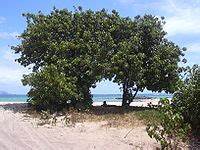
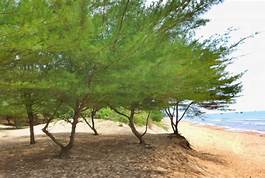
Cemara laut / Casuarina equisetifolia
As the name implies, sea cypress or shrimp fir can survive in coastal or coastal areas because it can prevent abrasion and withstand tsunami waves. Sea pine is still in the same family as mountain pine and Sumatran pine.
The height of the sea cypress tree can reach 50 meters with a trunk diameter of about 100 cm. Needle-shaped branches with a maximum length of up to 30 cm, the leaves are scaly and arranged in a circle with 6 to 10 strands in each book. Apart from preventing abrasion, sea cypress can also withstand wind gusts or wind barriers, big waves, and rehabilitate sandy land.
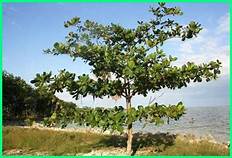
Ketapang / Terminalia catappa
The shape of the leaves is like an inverted egg, located at the end of a twig with a short stalk and a wide tip, getting smaller and tapering at the base. Ketapang has its own name, known in English as bengal almond, indian almond, malabar almond and so on.
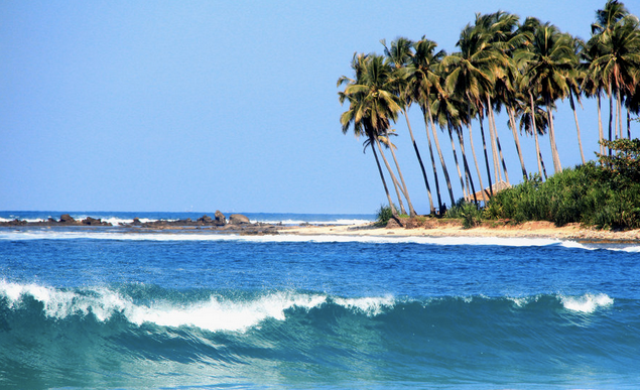
kelapa / Cocos nucifera
Most of us are certainly familiar with coconut, because this plant is mostly found in coastal areas. Historically coconut originated from the coast of the Indian Ocean in the Asian region, but nowadays coconut is grown in tropical coastal areas.
Coconut trees can reach 30 meters in height and can still survive at an altitude of 1,000 meters above sea level although their growth is not as good as in coastal areas. Almost every part of the plant is widely used by humans, from the roots, stems, leaves to the pulp.
Waru Laut / Hibiscus tiliaceus
Waru laut or baru laut including plants from the cotton-kapasan tribe are widely found as seafront or beach plants. Waru laut are widely distributed in coastal areas, especially tropical climates around the world, but according to history this plant originated from Asia, Africa and Europe.
Apart from the coastal area, this plant can also be found at an altitude of 800 meters above sea level with rainfall of around 900 – 2,500 per year. The adaptation of sea waru is very good, especially in sandy and salty environments, coral, lime, puddles and even basalt. Sea waru are found in several parts of the world such as eastern and western Australia, countries in the Oceania continent, the Maldives Islands, South Asia and Southeast Asia